
New Jersey divorce mediation costs $3,500 to $8,000 combined in 2026, while contested attorney-led litigation costs $15,000 to $50,000 or more per spouse — a gap of 70 to 90 percent that results from shared mediator fees, fewer court appearances, and a resolution timeline measured in months rather than years.
Divorce mediation in Monmouth County resolves property division, child custody, spousal support, and alimony through structured negotiation, so both spouses retain control over outcomes that a New Jersey Superior Court judge would otherwise decide.
New Jersey courts actively encourage alternative dispute resolution because mediated agreements produce more durable co-parenting and financial compliance outcomes than court-imposed judgments.
Key Takeaways
- New Jersey divorce mediation costs 70 to 90 percent less than contested attorney-led litigation in 2026, with mediation totaling $3,500 to $8,000 combined versus $15,000 to $50,000 or more per spouse in litigation.
- Mediated Marital Settlement Agreements become legally enforceable New Jersey court orders after a Superior Court judge reviews and incorporates the signed agreement into the Final Judgment of Divorce.
- High-conflict cases involving domestic violence, hidden assets, or one spouse’s refusal to negotiate require attorney representation and Superior Court intervention, regardless of the higher cost.
Coastal Business Services helps Monmouth County couples compare the two paths with a written cost estimate before making any financial commitment. Schedule your confidential consultation today.
If you’re ready to get started, call us now!
Divorce Mediation vs. Attorney Divorce in NJ: The 2026 Cost Comparison

New Jersey divorce mediation delivers cost savings over attorney-led litigation through three structural differences: both spouses share one mediator’s fee rather than funding two separate litigation attorneys; mediation sessions resolve disputes in 4 to 8 meetings rather than across months of court motion practice; and mediated divorces avoid the discovery subpoenas, depositions, and trial preparation that generate the largest attorney billing in contested cases.
Cost structure of New Jersey divorce mediation in 2026:
- One neutral mediator fee shared equally by both spouses ($200 to $500 per hour)
- 4 to 8 structured negotiation sessions totaling 8 to 15 hours
- No mandatory court appearance fees during the negotiation phase
- Marital Settlement Agreement drafting and New Jersey Superior Court filing fees ($300 to $350)
Cost structure of New Jersey attorney-led contested divorce in 2026:
- Two separate litigation attorney retainers — one per spouse at $300 to $600 per hour each
- Discovery phase document production requiring 20 to 40 attorney hours per side
- Multiple court motion hearings at $1,000 to $3,000 per appearance in attorney fees
- Deposition costs of $1,500 to $3,000 per deposition in attorney fees, plus $500 to $1,000 for court reporters
- Expert witness fees for business valuators, forensic accountants, and custody evaluators
| Divorce Method | 2026 Combined Cost | Average Timeline |
| Private Mediation | $3,500 – $8,000 | 2 – 4 months |
| Collaborative Divorce | $15,000 – $30,000 | 4 – 8 months |
| Attorney-Negotiated Settlement | $20,000 – $50,000 | 6 – 18 months |
| Contested Litigation | $30,000 – $100,000+ | 12 – 36 months |
Most New Jersey mediation cases resolve in 3 to 6 sessions. Contested attorney divorces require 12 to 24 months before the New Jersey Superior Court, Family Division, and sometimes longer when one spouse files successive motions or requests continuances.
Couples save by dividing one mediator’s fee and following a streamlined negotiation process.
Cases involving domestic violence, undisclosed assets, or complete refusal to participate require attorney representation because the discovery tools and judicial enforcement mechanisms available in litigation do not exist in private mediation.
What New Jersey Divorce Mediation Costs in 2026: Typical Ranges and What’s Included
New Jersey divorce mediation costs $3,500 to $8,000 in total for most straightforward cases in 2026. Under New Jersey Court Rule 1:40-4(b), roster mediators provide the first two hours of court-referred mediation at no charge, making court-connected mediation the lowest-cost entry point for New Jersey couples.
Private mediators in New Jersey charge $200 to $500 per hour, depending on professional background, certification level, and geographic market.
Simple cases involving limited assets and no contested parenting arrangements typically require 8 to 12 total hours.
Complex cases involving business ownership, multiple real estate properties, or disputed parenting time typically require 15 to 25 hours.
| Included in Standard Mediation Fees | Potential Additional Costs |
| Mediator’s time during joint and private sessions | Independent attorney review ($500 – $1,500 per spouse) |
| Between-session communication and document review | Licensed real estate appraiser ($400 – $800) |
| Memorandum of Understanding drafting | Certified Public Accountant or tax advisor ($200 – $500/hour) |
| Basic divorce paperwork guidance | New Jersey Superior Court filing fees ($300 – $350) |
| Simple asset division facilitation | Certified business valuator ($3,000 – $10,000) |
Both spouses divide the mediator’s hourly fee equally. Each spouse retains independent legal counsel separately to review the final Marital Settlement Agreement — an attorney review cost of $500 to $1,500 per spouse that protects both parties against inadvertent rights waivers.
How Much Does a Contested Attorney-Led Divorce Cost in New Jersey in 2026
A contested attorney-led divorce in New Jersey costs $15,000 to $50,000 per spouse in 2026, with total combined costs ranging from $30,000 to $100,000 or more in high-conflict cases involving business valuations, custody evaluations, or extended trial preparation.
The following cost categories drive the majority of litigation expenses.
Hourly Attorney Fees: New Jersey licensed family law attorneys charge $300 to $600 per hour in 2026, depending on experience level and county of practice. Bergen, Essex, and Morris County family law attorneys charge at the higher end of this range. Each spouse funds a separate attorney throughout the proceeding.
Discovery Phase Costs: New Jersey civil discovery requires both spouses to produce financial documents, property records, and supporting evidence. Litigation attorneys spend 20 to 40 hours per spouse on discovery alone at $300 to $600 per hour, adding $6,000 to $24,000 per side to the total before any hearings occur.
Deposition Costs: Each deposition requires attorney preparation time and attendance billed at the attorney’s hourly rate. Individual deposition costs range from $1,500 to $3,000 in attorney fees plus $500 to $1,000 for the certified court reporter.
Expert Witness Fees: Licensed expert witnesses charge separate fees for business valuations, property appraisals, and financial analysis. Certified business appraisers charge $5,000 to $15,000 per engagement. Licensed real estate appraisers charge $500 to $2,000 per property.
Child Custody Evaluations: Court-appointed custody evaluators — licensed psychologists or social workers credentialed under N.J.S.A. 9:2-4 — charge $3,000 to $8,000 per evaluation, which includes structured interviews with both parents, home visits, and standardized psychological testing where clinically indicated.
Court Appearances: Each motion hearing costs $1,000 to $3,000 in attorney fees, depending on the hearing’s duration and complexity. Contested New Jersey divorces involve multiple hearings on temporary support orders, discovery disputes, custody motions, and pretrial conferences.
Trial Preparation: New Jersey family court trial preparation requires 40 to 80 attorney hours per side, adding $12,000 to $48,000 in attorney fees before the trial begins. Contested trials add additional daily attorney fees during the proceeding itself.
Time to Resolution: Mediation vs. Litigation Timelines in New Jersey
New Jersey divorce mediation resolves most cases in 2 to 4 months from the first session to Superior Court filing. Contested attorney-led litigation requires 12 to 24 months before the Superior Court, Family Division, and extends beyond 24 months when one spouse files successive motions or requests continuances.
The New Jersey Judiciary’s Family Division reports that contested family court matters take 12 to 36 months to reach final judgment, depending on the county’s docket volume and the complexity of unresolved issues.
The New Jersey Superior Court, Monmouth County Vicinage, actively encourages mediation referrals to reduce contested case backlogs and accelerate resolution for families with minor children.
Court-connected custody mediation timeline in New Jersey:
- Weeks 1 to 2: Superior Court mediation referral and roster mediator scheduling
- Weeks 4 to 6: First mediation session (typically 2 to 3 hours)
- Weeks 8 to 12: Follow-up sessions (typically 2 to 4 additional sessions)
- Weeks 12 to 16: Memorandum of Understanding drafting and attorney review
- Weeks 16 to 20: Marital Settlement Agreement execution and Superior Court filing
Factors that extend mediation timelines:
- Contested business ownership interests requiring independent valuation
- Multiple real estate properties requiring licensed appraisals
- Parenting time disputes requiring child specialist involvement
- Incomplete financial disclosure requiring additional document production between sessions
When New Jersey divorce mediation fails to produce a full agreement, the case proceeds to contested litigation, adding 6 to 18 months to the total resolution timeline.
Superior Court scheduling constraints and mandatory discovery periods generate the longest delays in contested proceedings.
If you’re ready to get started, call us now!
Who Should Choose Mediation, and When Does Litigation Provide Better Protection?
New Jersey divorce mediation produces the best outcomes for couples who share financial transparency goals, can communicate without persistent coercion, and agree that maintaining co-parenting relationships matters more than maximizing individual outcomes through adversarial proceedings.
Six Circumstances That Require Litigation Rather Than Mediation
Active Domestic Violence or Coercive Control:
Domestic violence creates power imbalances that prevent meaningful negotiation. The New Jersey Supreme Court’s mediation standards explicitly exclude cases involving active domestic violence from court-connected mediation requirements, because victims cannot advocate effectively for equitable terms in the presence of an abuser.
Concealed Assets or Income:
New Jersey divorce mediation produces fair agreements only when both spouses provide complete financial disclosure. A spouse who conceals bank accounts, underreports business income, or hides retirement assets prevents the mediator from establishing the verified financial baseline that equitable negotiation requires.
Contested litigation provides subpoena authority, deposition rights, and access to forensic accounting that private mediation does not.
Active Substance Abuse Disorder:
A spouse experiencing active addiction may lack the cognitive clarity required to make binding long-term financial and parenting decisions. Agreements executed during active addiction face heightened risk of post-judgment legal challenge on grounds of diminished capacity.
Untreated Severe Mental Health Conditions:
Untreated severe psychiatric conditions that impair judgment or communication capacity render mediation inappropriate until the condition receives adequate clinical treatment and the affected spouse can participate meaningfully in structured negotiation.
Complete Refusal to Participate:
Private divorce mediation requires voluntary, good-faith participation from both spouses. A spouse who refuses to attend sessions, attends only to obstruct, or consistently misrepresents financial information, forces the proceeding to contested litigation where the Superior Court exercises authority to compel disclosure and impose judgment.
Child Safety Concerns Requiring Judicial Investigation:
Contested custody cases involving allegations of child abuse, parental alienation, or substance abuse require the Superior Court’s investigative authority — including guardian ad litem appointments, forensic interviews of children, and structured custody evaluations — that fall outside the mediator’s role and jurisdiction.
The Hybrid Approach: Starting with Mediation and Transitioning Selectively
Many Monmouth County couples resolve most issues through mediation and litigate only the specific disputes that mediation cannot resolve.
This hybrid approach captures mediation’s cost and timeline advantages for straightforward issues while preserving litigation’s enforcement mechanisms for genuinely contested matters.
Common hybrid strategies for New Jersey divorces in 2026:
- Mediate the parenting plan and child support calculation while litigating contested business valuation
- Resolve residential property division through mediation while litigating disputed retirement account QDROs
- Mediate basic asset allocation while engaging independent attorneys to negotiate complex stock option or deferred compensation provisions.
Retaining independent legal counsel for document review during mediation — rather than for full litigation representation — provides legal protection at $500 to $1,500 per spouse in attorney review fees rather than $15,000 to $50,000 or more in full litigation costs.
Common Add-On Costs in New Jersey Divorce Mediation and How to Control Them
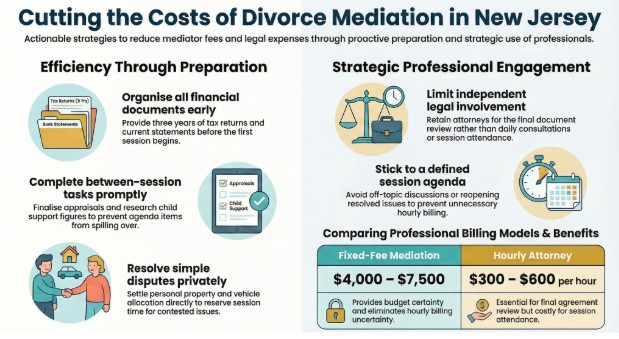
New Jersey divorce mediations frequently generate additional costs beyond the mediator’s hourly fee.
Document preparation, additional sessions beyond the initial estimate, and independent attorney consultations typically add $1,000 to $3,000 to the base mediation cost.
strategies that reduce add-on costs in New Jersey divorce mediation:
Organize all financial documents before the first session.
Both spouses should deliver three years of federal and New Jersey state tax returns, recent pay stubs, bank and investment account statements, mortgage statements, and retirement account statements to the mediator before the first session begins.
Mediators who spend session time locating and reviewing financial documents bill that time at their full hourly rate.
Complete all mediator-assigned between-session tasks promptly.
New Jersey divorce mediators regularly assign tasks between sessions — obtaining property appraisals, reviewing proposed parenting plan terms, or researching applicable New Jersey child support guideline figures. Delayed completion forces agenda items into the next paid session.
Negotiate straightforward issues outside of mediation sessions.
Personal property division, vehicle allocation, and basic bank account separation frequently qualify for direct resolution between spouses without the need for a mediator.
Reserving time for mediation sessions on genuinely contested financial and parenting issues reduces the total session count.
Request a fixed-fee engagement where the mediator offers this structure.
Some New Jersey mediators offer flat-rate packages ranging from $4,000 to $7,500 for standard cases, covering a defined number of sessions and drafting a Memorandum of Understanding. Fixed-fee arrangements provide budget certainty and eliminate uncertainty around hourly billing.
Limit independent attorney involvement to final agreement review.
Independent legal counsel provides essential protection when reviewing the final Marital Settlement Agreement.
Daily attorney consultations throughout the mediation process add legal fees of $300 to $600 per hour, which are disproportionate to their benefit. Retaining attorneys for final document review — not session attendance — controls this cost category.
Stay on the session agenda and resolve secondary disputes between sessions.
Off-topic discussions and reopened previously resolved issues extend session duration and increase total mediator billing. Both spouses benefit from entering each session with written priorities and a realistic understanding of the session’s defined agenda.
How Enforceable Are Mediated Agreements in New Jersey?
A New Jersey mediated divorce agreement becomes a legally enforceable Superior Court order after both spouses execute the Marital Settlement Agreement and a Superior Court judge reviews and incorporates it into the Final Judgment of Divorce.
The Marital Settlement Agreement carries the same legal weight as any other court order — violation triggers contempt proceedings, wage garnishment, or other enforcement mechanisms available under New Jersey family law.
The Enforcement Process: From Memorandum of Understanding to Court Order
The New Jersey divorce mediation process produces a Memorandum of Understanding (MOU) that captures all agreed-upon terms regarding property division, child custody, parenting time, child support, and spousal support.
The MOU is not enforceable on its own — enforceability requires the following additional steps.
Both spouses’ independent attorneys convert the Memorandum of Understanding into a formal Marital Settlement Agreement (MSA) that uses precise legal language, specifies exact dollar amounts and payment schedules, and addresses all required provisions under New Jersey family law. Both spouses and their attorneys execute the MSA.
One spouse files the executed MSA with the New Jersey Superior Court, Family Division, as part of the uncontested divorce complaint. A Superior Court judge reviews the MSA to confirm it meets New Jersey legal standards and — for custody provisions — protects the best interests of any minor children under N.J.S.A. 9:2-4.
The judge incorporates the MSA into the Final Judgment of Divorce, converting the private agreement into a binding court order.
A spouse who fails to comply with the terms of the Marital Settlement Agreement after the judgment is entered faces enforcement proceedings in Superior Court.
New Jersey courts treat MSA violations the same as violations of any other court order — including contempt charges, license suspension, credit reporting, and wage garnishment for support obligations.
Ten-Point Decision Checklist: Mediation or Litigation for Your New Jersey Divorce?
1. Can both spouses communicate without persistent hostility or intimidation? New Jersey divorce mediation requires structured communication between both spouses. Active intimidation, threats, or coercive communication patterns during sessions indicate that the judicial framework of litigation provides better protection than mediation’s facilitated negotiation.
2. Will both spouses provide complete and accurate financial disclosure? Mediation requires voluntary financial transparency from both spouses. A spouse who withholds bank statements, underreports business income, or refuses to produce retirement account records prevents the mediator from establishing the verified financial baseline that equitable negotiation requires.
3. Do the marital assets include business ownership interests or complex financial instruments? Simple marital estates — a shared residence, joint bank accounts, and standard retirement accounts — are well-suited to mediation. Cases involving closely held business interests, stock option portfolios, defined benefit pension plans, or commercial real estate typically benefit from attorney representation and discovery authority.
4. Does either spouse have a documented history of domestic violence or active coercive control? Domestic violence disqualifies a case from court-connected mediation under New Jersey Supreme Court mediation standards. Private mediation in domestic violence cases creates safety risks and power imbalances that produce unfair agreements.
5. How quickly does each spouse need the divorce finalized? New Jersey divorce mediation resolves most cases in 2 to 4 months from the first session to the Superior Court filing. Contested attorney-led litigation requires 12 to 24 months or longer before the New Jersey Superior Court, Family Division.
6. What is each spouse’s budget for divorce costs in 2026? New Jersey divorce mediation costs $3,500 to $8,000 combined in 2026. Contested attorney-led litigation costs $15,000 to $50,000 or more per spouse — a combined range of $30,000 to $100,000 or beyond in high-conflict cases.
7. Do both spouses prioritize confidentiality over public court record transparency? Communications in New Jersey divorce mediation receive confidentiality protection under New Jersey Rule of Evidence 519. Contested litigation produces a public court record accessible to anyone who searches the Superior Court’s docket.
8. Do the parties agree on basic parenting arrangements for minor children? Parenting time disputes involving allegations of child abuse, substance abuse, or parental alienation require the Superior Court’s investigative authority — including guardian ad litem appointments and court-ordered custody evaluations — that fall outside the mediator’s jurisdiction.
9. Can both spouses compromise on major financial and parenting issues? New Jersey divorce mediation requires mutual compromise from both spouses to produce a complete Marital Settlement Agreement. A spouse who refuses to negotiate on any material issue forces the proceeding to contested litigation.
10. Does either spouse require immediate court-ordered financial protection? Mediated agreements become enforceable only after the Superior Court’s entry of the Final Judgment of Divorce. Spouses who require immediate temporary support orders, restraining orders on marital assets, or emergency custody orders need attorney representation and Superior Court motion practice that mediation cannot provide.
How to Identify a Qualified New Jersey Divorce Mediator or Family Law Attorney
The New Jersey Association of Professional Mediators (NJAPM) maintains a publicly searchable directory of credentialed mediators, including those listed on the New Jersey Administrative Office of the Courts’ official Roster of Trained Civil and Family Mediators.
The New Jersey State Bar Association Lawyer Referral Service connects prospective clients with licensed New Jersey family law attorneys by county and practice concentration.
Credentials to verify before retaining a New Jersey divorce mediator:
- Current listing on the New Jersey Administrative Office of the Courts’ official mediator roster
- Completion of a recognized family mediation training program of at least 40 hours
- Demonstrated experience mediating New Jersey divorce cases in the relevant asset categories — business ownership, retirement account division, contested parenting arrangements
- Professional membership in the New Jersey Association of Professional Mediators or the Association for Conflict Resolution
Credentials to verify before retaining a New Jersey family law attorney:
- Active New Jersey bar admission in good standing with the New Jersey Office of Attorney Ethics
- Demonstrated family law concentration with verifiable Superior Court, Family Division case experience
- Familiarity with Monmouth County Vicinage court procedures and judicial assignment practices
- Membership in the New Jersey State Bar Association Family Law Section or the Monmouth County Bar Association
Coastal Business Services helps Monmouth County couples understand the financial implications of both mediation and contested litigation before selecting a path. Contact Coastal Business Services to receive a written cost comparison and local mediator referrals matched to your specific case profile.
If you’re ready to get started, call us now!
Frequently Asked Questions
How much does divorce mediation cost compared to a litigated divorce in New Jersey in 2026?
New Jersey divorce mediation costs $3,500 to $8,000 combined in 2026. Contested attorney-led litigation costs $15,000 to $50,000 per spouse — a combined range of $30,000 to $100,000 or more — producing a cost gap of 70 to 90 percent in favor of mediation for cooperative couples.
Does a mediated divorce agreement become legally binding in New Jersey?
A signed Marital Settlement Agreement becomes a legally binding New Jersey court order after the Superior Court, Family Division judge reviews and incorporates it into the Final Judgment of Divorce. A spouse who violates the filed agreement faces enforcement proceedings in Superior Court, including contempt charges and wage garnishment for support obligations.
Can each spouse retain an attorney during New Jersey divorce mediation?
Each spouse may retain independent legal counsel and bring that attorney to mediation sessions, or engage the attorney exclusively for between-session review and advice. Most Monmouth County couples retain attorneys for limited-scope representation — document review and legal advice — while keeping attorney attendance at sessions optional to control total costs.
How long does mediation take compared to contested litigation in New Jersey? New Jersey divorce mediation resolves most cases in 2 to 4 months from the first session to the Superior Court filing. Contested attorney-led litigation requires 12 to 24 months before the New Jersey Superior Court, Family Division, and may extend beyond 24 months when successive motions or discovery disputes delay the proceeding.
When does New Jersey divorce mediation become inappropriate or unsafe?
New Jersey divorce mediation becomes inappropriate when one spouse has a history of domestic violence or coercive control, either spouse conceals assets or income, one spouse experiences active substance abuse disorder or untreated severe mental health conditions, a significant power imbalance prevents equitable negotiation, or one spouse refuses to participate in good faith.
Does a mediated parenting plan protect each parent’s rights in New Jersey?
A mediated parenting plan incorporated into the Final Judgment of Divorce carries full court order status and protects each parent’s rights under N.J.S.A. 9:2-4. The New Jersey Superior Court, Family Division, retains authority to modify custody and parenting time orders when a material change in circumstances occurs after the judgment is entered.
What qualifications should a couple verify before hiring a New Jersey divorce mediator or family law attorney?
For mediators: verify current listing on the New Jersey Administrative Office of the Courts’ official mediator roster, completion of a recognized 40-hour family mediation training program, demonstrated experience with New Jersey divorce cases, and a transparent written fee structure. For attorneys: verify active New Jersey bar admission in good standing, demonstrated family law concentration, Monmouth County Vicinage experience, and membership in the New Jersey State Bar Association Family Law Section.