
To get divorced without going to court in New Jersey, both spouses must reach a full agreement through mediation or negotiation, sign a Marital Settlement Agreement, and file an uncontested divorce complaint with the Superior Court. The judge reviews and approves the agreement but does not conduct a trial.
New Jersey couples can finalize a divorce without a courtroom trial by using mediation, reaching a full written agreement, and filing for an uncontested divorce.
The court still issues the Final Judgment of Divorce, but most couples who mediate successfully avoid contested hearings, cross-examination, and repeated appearances before the judge entirely.
Divorce mediation in Monmouth County gives both spouses control over outcomes that a judge would otherwise decide. A neutral mediator guides discussions on property division, parenting arrangements, child support, and alimony in a private setting — at a fraction of the cost of litigation.
Key Takeaways
- New Jersey couples avoid a courtroom trial by mediating all major issues and filing as uncontested — the court’s role becomes primarily administrative.
- Mediation costs $3,000 to $6,000 on average, compared to $30,000 to $60,000 or more for contested litigation.
- At least one spouse must have lived in New Jersey for 12 consecutive months before filing a divorce complaint under N.J.S.A. 2A:34-10.
Can You Get Divorced Without Going to Court in New Jersey?
Yes. New Jersey couples finalize their divorce without a trial by mediating all major disputes and filing an uncontested complaint with the Superior Court, Family Division. “Without court” means avoiding contested hearings — not skipping the legal process altogether.
The court still receives and reviews your paperwork. A judge signs the Final Judgment of Divorce. But when both spouses agree on every material issue, that judicial review is largely administrative.
Many Monmouth County couples complete the process without appearing before a judge more than once, and some never appear at all, depending on the county and the completeness of their filing.
What “Without Court” Actually Means in New Jersey
When couples say they divorced without going to court, they typically mean they avoided the following:
| What You Can Avoid | What Still Must Happen |
| Contested hearings and trial days | Filing a Complaint for Divorce with the Superior Court |
| Testifying or being cross-examined | Submitting a signed Marital Settlement Agreement |
| Repeated judge appearances | Allowing a judge to review and enter the final judgment |
| Public disclosure of financial details | Meeting New Jersey’s 12-month residency requirement |
The distinction matters because some attorneys and online guides overstate what “court-free” means. No-fault, uncontested divorces in New Jersey still run through the court system — they just do not require litigation.
When a Low-Court Divorce Is Realistic
A mediated or uncontested divorce works when both spouses can negotiate honestly and commit to disclosure. The following conditions make a low-court outcome achievable:
- Both spouses communicate without persistent hostility
- Neither party conceals income, assets, or debts
- Both are willing to compromise on property and parenting terms
- No active domestic violence restraining orders exist
- Children’s needs can be discussed without one parent weaponizing custody
If domestic violence, hidden assets, or a complete refusal to cooperate is present, the court requires deeper involvement. Even then, a non-cooperating spouse cannot indefinitely delay a divorce in New Jersey — the filing spouse can proceed to a default hearing.
Contact Coastal Business Services to find out whether your situation is a good fit for mediation. Schedule a confidential consultation with our Monmouth County team today.
If you’re ready to get started, call us now!
Mediation vs. Other Out-of-Court Divorce Options in New Jersey
New Jersey offers four primary paths for couples who want to avoid trial. Understanding what a mediator does in a New Jersey divorce helps couples choose the right approach before committing to a process.
| Method | Average Cost | Timeline | Best For |
| Mediation | $3,000 – $6,000 | 2 – 4 months | Cooperative couples, moderate complexity |
| Collaborative Divorce | $15,000 – $25,000 | 4 – 8 months | Complex finances, want an attorney present |
| Attorney-Negotiated Settlement | $10,000 – $30,000 | 3 – 12 months | Poor communication, moderate conflict |
| DIY / Uncontested Filing | $500 – $2,000 | 1 – 3 months | Full agreement already reached, no complexity |
Divorce Mediation
Mediation places a neutral third party — the mediator — between both spouses to facilitate a structured discussion. The mediator does not represent either spouse, provide legal advice, or make binding decisions. Both spouses negotiate directly, guided by the mediator’s framework.
Sessions run informally, either in an office or via video conference. Each spouse can retain independent legal counsel to review proposals between sessions. Once both parties reach an agreement, the mediator helps draft a Memorandum of Understanding, which the attorneys convert into a formal Marital Settlement Agreement.
Mediation is voluntary and confidential. Either spouse can end the process if it stops working. New Jersey courts cannot force private mediation, though they can order court-connected mediation in contested cases.
Collaborative Divorce
Collaborative divorce requires both spouses to hire collaboratively trained attorneys who sign a participation agreement committing everyone to settlement. Financial neutrals, child specialists, and other professionals join the process as needed.
The key structural difference from mediation is that each spouse has an attorney present at every meeting.
If the collaborative process fails and either spouse files for litigation, both collaborative attorneys must withdraw, and both spouses must hire new counsel. This withdrawal clause incentivizes settlement.
Collaborative divorce costs more than mediation but less than contested litigation. It suits couples with complex business interests, significant retirement assets, or children with special needs.
Attorney-Negotiated Settlements
Each spouse retains separate counsel. The attorneys communicate directly — by phone, letter, or email — to negotiate terms without requiring the spouses to sit together. This path works when communication between spouses has broken down, but both sides remain committed to avoiding trial.
DIY and Uncontested Filings
Couples who have already agreed on every term can file directly as uncontested without a mediator. One spouse files the complaint, submits the signed Marital Settlement Agreement, and the court schedules a brief review hearing. This is the lowest-cost path but carries significant risk if the agreement contains errors, omissions, or terms that conflict with New Jersey law.
Step-by-Step: The New Jersey Mediation Path to a Court-Free Divorce
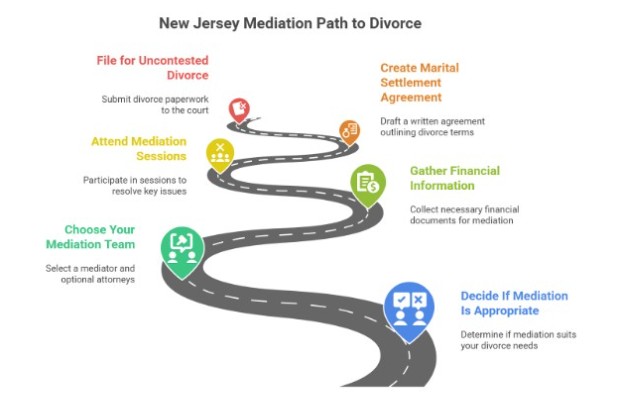
The six steps below describe private mediation — the most common path for Monmouth County couples seeking to avoid courtroom litigation.
Review the New Jersey divorce mediation checklist before your first session to ensure you arrive prepared.
Step 1 — Confirm Mediation Fits Your Situation
Mediation requires voluntary participation and honest disclosure from both spouses. Before scheduling a mediator, both people must honestly assess whether the following apply:
- Can you discuss difficult financial and parenting topics without the conversation becoming abusive?
- Are both spouses willing to disclose income, assets, debts, and expenses fully?
- Is domestic violence absent from the relationship, or safely managed through separate sessions?
- Does neither spouse intend to use delay tactics to exhaust the other financially?
Even high-conflict couples sometimes mediate successfully with experienced mediators who use separate caucusing — holding discussions with each spouse individually rather than jointly.
Complex finances, business ownership, or retirement assets do not disqualify a couple from mediation. Unwillingness to disclose or negotiate does.
Step 2 — Choose Your Mediator and Clarify Legal Support
The mediator acts as a neutral facilitator. In New Jersey, mediators come from legal, financial, and mental health backgrounds.
New Jersey Supreme Court Approved Civil Mediators maintain certification through the Administrative Office of the Courts, though private mediators are not required to hold this certification.
When evaluating candidates, ask the following:
- How many New Jersey divorce mediations have you conducted in the past three years?
- What is your hourly rate, and how do you handle sessions that run long?
- Do you use joint sessions, caucuses, or both?
- Will you draft the Memorandum of Understanding, or does that fall to attorneys?
Rates for private mediators in New Jersey range from $150 to $450 per hour, depending on credentials and location. Many Monmouth County mediators offer an initial consultation at no charge.
Each spouse should retain independent legal counsel, even if the attorneys do not attend the sessions.
Attorneys review proposals, identify rights the spouse may be inadvertently waiving, and confirm the final agreement meets New Jersey family law requirements before signing.
Step 3 — Gather and Exchange Financial Documents
Complete financial disclosure is the foundation of every mediated divorce. New Jersey court rules require both spouses to complete a Case Information Statement (CIS) — a detailed financial disclosure form — as part of any divorce filing.
Gathering these documents before mediation begins saves sessions and reduces hourly costs.
Documents both spouses should prepare:
- Federal and state tax returns for the past three years
- Recent pay stubs covering at least the past three months
- Bank statements for all personal and joint accounts
- Retirement account statements (401k, IRA, pension)
- Mortgage statements, property deeds, and the most recent property tax assessment
- Vehicle titles and outstanding loan balances
- Credit card statements and other debt documentation
- Business financial statements if either spouse owns a business
- Life insurance policies showing cash value and beneficiary designations
- Health insurance documentation
An incomplete or inaccurate disclosure can invalidate a mediated agreement after the court enters it as a judgment. If a spouse later discovers concealed assets, New Jersey courts can reopen the judgment.
Step 4 — Work Through the Four Core Issues in Mediation Sessions
Most New Jersey divorce mediations resolve four categories of issues. The 2025 New Jersey mediation laws governing each area set the framework mediators use to help couples reach enforceable agreements.
Child Custody and Parenting Time Legal custody determines which parent makes major decisions about education, healthcare, and religion. Physical custody determines where the child lives and the parenting time schedule. New Jersey courts apply the best interests of the child standard under N.J.S.A. 9:2-4.
Mediators help parents build realistic parenting plans that cover school schedules, holidays, vacations, transportation, and communication protocols.
Child Support New Jersey calculates child support using the Income Shares Model under the NJ Child Support Guidelines. The calculation considers both parents’ gross income, the parenting time schedule, healthcare costs, and childcare expenses.
Mediators walk couples through the guidelines calculation and address situations — like self-employment income or variable bonuses — that require more detailed analysis.
Alimony and Spousal Support: New Jersey recognizes four types of alimony under N.J.S.A. 2A:34-23: open durational, limited-duration, rehabilitative, and reimbursement. The mediator helps both spouses evaluate factors including the length of the marriage, each spouse’s earning capacity, the marital standard of living, and each party’s contributions — financial and non-financial — to the marriage. Grey divorce cases in New Jersey involving long marriages and retirement-age spouses require particularly careful alimony analysis.
Equitable Distribution of Assets and Debts New Jersey divides marital property equitably, not necessarily equally, under N.J.S.A. 2A:34-23.1. The marital home, retirement accounts, investment accounts, vehicles, business interests, and joint debts all require valuation and allocation.
The mediator helps both spouses assess options — such as one spouse buying out the other’s equity — and understand the tax implications of each scenario. A financial neutral can assist with complex asset analysis during mediation.
Step 5 — Draft and Review the Marital Settlement Agreement
Once both spouses have resolved all four core issues, the mediator produces a Memorandum of Understanding that summarizes all agreed-upon terms.
Attorneys for each spouse convert this document into a formal Marital Settlement Agreement (MSA).
The MSA must address every material issue to avoid future disputes. Effective MSAs specify the following:
- Exact dollar amounts and payment schedules for support obligations
- The date and method for each asset transfer
- Specific language for retirement account division, including any required Qualified Domestic Relations Order (QDRO)
- A detailed parenting plan with holiday schedules, vacation protocols, and a dispute resolution mechanism
- How future expenses — college costs, medical costs, extracurricular activities — will be shared
- What happens if either spouse fails to meet their obligations
Both attorneys review the draft before their clients sign. Attorneys may propose revisions to protect their client’s rights or correct terms that conflict with New Jersey law. Once both spouses and attorneys approve the language, each spouse signs.
The signed MSA becomes the primary document submitted to the court.
Step 6 — File the Uncontested Divorce and Obtain the Final Judgment
One spouse files a Complaint for Divorce with the Superior Court, Family Division, in the county where either spouse resides. New Jersey requires at least one spouse to have lived in the state for 12 consecutive months immediately preceding the filing date under N.J.S.A. 2A:34-10.
Most mediated divorces in New Jersey are filed under the no-fault ground of irreconcilable differences, which requires only that the marriage has broken down for at least 6 months and that there is no reasonable prospect of reconciliation.
This ground requires no proof of wrongdoing and aligns naturally with the mediation process.
The filing spouse submits the complaint, the signed MSA, the Case Information Statement, a proposed Final Judgment of Divorce, and supporting exhibits. The non-filing spouse files an appearance confirming receipt of the documents and not contesting the terms.
A judge reviews the submission. If the agreement is complete, legally sound, and — for custody matters — consistent with the best interests of the children, the judge enters the Final Judgment of Divorce.
Many uncontested cases in New Jersey resolve without a hearing. Some counties require a brief in-person or telephonic appearance to confirm the agreement on the record.
If you’re ready to get started, call us now!
What Does Divorce Mediation Cost in New Jersey Compared to Litigation?
Mediation costs significantly less than contested litigation in New Jersey. The following comparison reflects typical costs for private mediation and attorney-driven litigation in Monmouth County divorces in 2026.
| Cost Category | Mediation | Contested Litigation |
| Professional fees | $3,000 – $6,000 (shared mediator) | $15,000 – $50,000+ per spouse |
| Attorney fees | $1,500 – $5,000 (review only) | $15,000 – $30,000+ per spouse |
| Court filing fees | $300 – $350 | $300 – $350 |
| Expert witnesses | Rarely needed | Often required |
| Total typical range | $5,000 – $12,000 combined | $30,000 – $100,000+ combined |
| Average timeline | 2 – 4 months | 12 – 24+ months |
The primary driver of mediation cost is the number of sessions required. Couples who arrive prepared — with complete financial documents and a realistic understanding of New Jersey guidelines — typically complete mediation in three to six sessions.
Couples who arrive unprepared or who cannot agree on basic financial facts spend more time and money in session.
Litigation costs escalate because each spouse pays separate attorney hourly rates for every letter, phone call, court appearance, and discovery request.
Expert witnesses — forensic accountants, business valuators, custody evaluators — add substantial costs that mediation typically avoids.
Key New Jersey Law Every Mediating Couple Should Understand
Residency and Filing Requirements
New Jersey requires at least one spouse to have lived in the state for 12 consecutive months before filing for divorce under N.J.S.A. 2A:34-10. The filing spouse submits the complaint to the Superior Court, Family Division, in the county where either spouse currently lives.
No-Fault Grounds: Irreconcilable Differences
Most mediated divorces in New Jersey are filed under the irreconcilable differences ground, codified at N.J.S.A. 2A:34-2(i).
This ground requires only that irreconcilable differences have caused the breakdown of the marriage for a period of at least six months and that there is no reasonable prospect of reconciliation.
No separation period is required. No wrongdoing needs to be proven. This makes it a natural fit for couples choosing mediation.
Court-Ordered vs. Private Mediation
New Jersey courts can order mediation in contested cases where custody or parenting time remains in dispute. Court-connected mediation uses court-approved mediators, follows a structured schedule, and may be provided at low or no cost depending on the couple’s income.
Private mediation — the path most Monmouth County couples choose — allows the couple to select their own mediator, set their own schedule, and work at their own pace.
When Mediation Is Not Appropriate
Certain circumstances make mediation unsafe or impractical, regardless of cost savings:
Domestic Violence: Active abuse or a history of coercive control creates power imbalances that prevent meaningful negotiation. Victims often cannot advocate effectively for themselves under the same roof as their abuser, even with a skilled mediator present.
Hidden Assets: Mediation produces fair agreements only when both spouses disclose fully. A spouse who conceals income, undervalues business interests, or hides accounts undermines the process. Discovery tools available in litigation — subpoenas, depositions, forensic accountants — do not exist in private mediation.
Substance Abuse or Mental Health Crisis: A spouse experiencing active addiction or an untreated severe mental health condition may lack the capacity to make informed, binding decisions.
Complete Refusal to Participate: Mediation requires both spouses to participate. If one refuses to attend or attends only to obstruct, the process cannot function. Litigation becomes the only path.
How to Choose the Right Divorce Mediator in New Jersey
Credentials and New Jersey Experience
New Jersey does not license private divorce mediators, which means credentials vary widely. The most relevant qualifications include completion of a recognized family mediation training program, familiarity with New Jersey Superior Court family division procedures, and demonstrated experience with the specific issues in the couple’s case.
Ask any prospective mediator to describe how they have handled cases involving business ownership, retirement account division, or high-conflict parenting disputes — whichever issues apply to your situation.
A mediator whose background is entirely in commercial dispute resolution may lack the family-dynamics skills divorce requires.
Financial Competence Beyond Basic Division
Divorce settlements carry long-term financial consequences that extend well beyond the date of the final judgment. A financially competent mediator understands how to evaluate retirement account options and QDRO requirements, the tax treatment of different asset transfers, the impact of the marital home decision on each spouse’s post-divorce budget, and how child support and alimony interact with each spouse’s tax filing status.
Coastal Business Services brings financial expertise directly into the mediation process. Our Monmouth County divorce mediation team provides structured financial analysis — settlement scenario modeling, asset valuation support, and post-divorce budget projections — that helps couples make informed decisions rather than reactive ones.
Red Flags to Avoid
Certain mediator behaviors signal a process unlikely to produce a durable, enforceable agreement:
- Pressuring either spouse to accept terms before they have consulted independent counsel
- Displaying favoritism toward one spouse through tone, attention allocation, or response patterns
- Refusing to explain their fee structure in writing before the first session
- Claiming they can guarantee specific outcomes
- Discouraging either spouse from seeking independent legal advice
- Demonstrating no knowledge of current New Jersey family law or child support guidelines
A neutral mediator never discourages legal counsel. Independent attorney review protects both spouses and produces agreements less likely to be challenged later.
How Coastal Business Services Supports Court-Free Divorce in Monmouth County
Coastal Business Services provides structured, financially grounded divorce mediation for couples in Monmouth County and surrounding New Jersey communities.
The firm focuses specifically on the financial dimensions of divorce — the area where most mediation sessions stall and most agreements later break down.
What Coastal Business Services handles in the mediation process:
- Complete financial disclosure, organization, and review
- Marital asset and debt inventory with current valuations
- Settlement scenario modeling showing the long-term financial impact of each proposed division
- Child support and alimony calculations based on New Jersey guidelines
- Business interest valuation support for couples who own companies together
- Tax consequence analysis for asset transfer options
- Post-divorce budget planning for each spouse
The firm does not provide legal advice and does not replace independent attorneys. Coastal Business Services builds the financial foundation that makes mediation sessions faster, more focused, and more likely to produce agreements that both spouses can sustain over the long term.
Couples who use professional divorce mediation services in Red Bank, NJ, and Asbury Park, NJ, report that having organized financial data on hand reduces session time and eliminates the most common source of conflict — disagreement about what the numbers actually are.
If you and your spouse are considering mediation, start with a confidential financial assessment.
Contact Coastal Business Services to schedule your initial consultation and find out what a structured, court-free divorce could look like for your family.
If you’re ready to get started, call us now!
Frequently Asked Questions
Can you get divorced without going to court in New Jersey?
Many New Jersey couples finalize a divorce without a courtroom trial by mediating all major issues and filing as uncontested. The court still reviews the agreement and enters the Final Judgment of Divorce, but contested hearings and trials are avoided entirely.
How does divorce mediation work in New Jersey if we want to avoid court?
A neutral mediator facilitates a structured discussion between both spouses on custody, support, and property division. Once both spouses reach an agreement, attorneys draft a Marital Settlement Agreement that is submitted to the court for review and approval.
Do we still have to file paperwork with the court if we mediate?
Yes. New Jersey requires one spouse to file a Complaint for Divorce with the Superior Court, even in mediated cases. The court reviews the Marital Settlement Agreement and enters a Final Judgment of Divorce, thereby legally ending the marriage.
How long does a mediated divorce take in New Jersey?
Most couples in Monmouth County complete mediation in three to six sessions over two to four months. The total timeline from filing to Final Judgment depends on the county’s docket and the completeness of the submitted paperwork.
How much does a divorce without court typically cost in New Jersey?
Mediated and uncontested divorces typically cost $5,000 to $12,000 combined, including mediator fees and attorney review. Contested litigation frequently costs $30,000 to $100,000 or more in combined fees per couple.
Do we need lawyers if we use mediation in New Jersey?
Attorneys are not required to attend mediation sessions, but each spouse should retain independent legal counsel to review the final Marital Settlement Agreement before signing. Attorney review protects both parties and reduces the risk of future challenges to the agreement.
What happens if mediation fails — will we end up in court?
If mediation does not result in a full agreement, couples can pursue a collaborative divorce or an attorney-negotiated settlement. If those paths also fail, a contested court proceeding becomes necessary, and a judge resolves the remaining disputes.
What issues does a mediator help resolve in a New Jersey divorce?
A New Jersey divorce mediator facilitates the resolution of child custody and parenting time, child support calculations, alimony type and duration, and equitable distribution of all marital assets and debts. The mediator does not provide legal advice or make binding decisions.